Jeff Counts: Kate Beecroft, welcome to On Set.
Kate Beecroft: Thank you so much.
JC: So the origin story of East of Wall is that the Zamigas are very real people and that you came across their ranch by chance. That last part cannot be true. You were always looking for them, right, and you just didn’t know it?
KB: It feels that way. I was just, you know, I was on a road trip with my cinematographer, just driving across the U.S. And I took a wrong turn and I met a woman and she told me to head east of Wall and try to find a woman named Tabatha and her family and so I did and I ended up living there for three years.

JC: So why not tell their story as a straight documentary? Why did you decide to take on the challenge of creating something semi-fictional with them?
KB: Yeah, you know, I get asked that a lot, of course, because docu-fiction is somewhat newer of a genre, especially in America. I think that being a documentary filmmaker is a very specific skill, and I don’t have that skill. I love working with actors. I also really love discovering new talents. So when someone launches this film, yes, it feels docu-fiction, but I also want people to be like, oh, wow, here are new artists as well, because I think they are artists.
JC: The landscape of the American West is very photogenic. We all know that. But the same could be said of the despair that one often finds out here. That looks pretty good on camera, too. And I think you strike a great harmony between the beauty and the tragedy. So did you struggle to find that balance between the myths and the truths about a life like the Zimigas?
KB: You know, I think that if I made this film, let’s say the week that I met them, it would be a very different film than after living with them for three years and then shooting it. Because I found, after all these years living with him, so much beauty in their despair and how they carry it on. And I ended up having immense respect for it and just realizing the joy and the beauty that comes along with it. So that was really important for me to capture in a way that was sensitive.
JC: Women are at the heart of East of Wall. And I’ve seen you say in interviews that this is very intentional. Talk about why it was important to you to tell this kind of story in a genre that is so dominated by men’s perspectives.
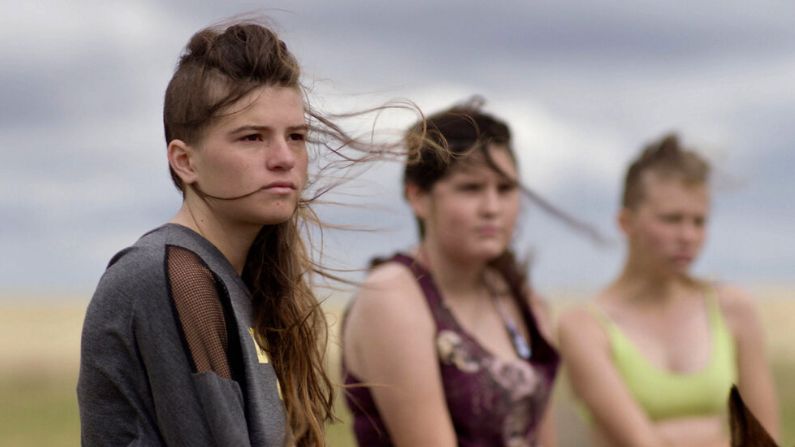
KB: There’s just so many Westerns and the Western culture is so alive right now, right? And people are infatuated with it and everyone wants to put on a cowboy hat. And now I was realizing that none of those stories are told through the voices of women, especially women who’ve actually lived it. So for me, that was important. Also, I’ve just been dying to see faces like theirs hold screen for so long. The feralness of teenage girls, you know, and all of that. Yeah, it was so it’s just a new kind of modern western for me that I’d never seen befor,e and yeah that’s why I felt like I needed to make this and have this be about women, because when I’m on ranches, all I’m staring at are like the women who are branding with a baby on their hip.
JC: People have been filming horses in motion since literally the very first moving picture in the 1870s. So what was it like to be around such unbelievable riders in their element?
KB: It makes me emotional. The bond that they have with their horses has saved their life in many ways. And that’s not me saying that lightly. That is a very specific bond. And all of these horses in the film, there’s no Hollywood horses. They are horses that Tabby has rescued from the Kill Pen. So they’re all horses who people threw away and Tabby gave them a second chance and she trained them all to specifically what I needed. In the film, which I always brag about that for Tabby because I think that’s so cool and she never mentions it in any interviews, you know.
JC: I’m sure people always ask you what you hope audiences will take away from this experience, but I’m more interested in what you as a filmmaker have taken away from the experience. What do you carry with you from “East of Wall” as you go forward into your career?
KB: I think doing something like “East of Wall,” which is docu-fiction, requires you to, yes, you do all your prep and all your homework before, but you need to let go of it because you can’t prep too much for docu-fiction. You have to follow their lead as a cast. And so, you know, it’s… That really helped me and I wanna take that going forward of that I can’t hold on too tightly to what I expect things to be or how I want things to go because I’m really gonna miss the magic. And when you’re working with first-time actors and non-professional actors, they’re giving you magic all the time. So you have to get out of your head and just see what’s in front of you because just being a human being is enough, you know, and seeing what they have behind their eyes and what they’re given forward is such a gift and I wanna be able to discover. More talent like them and yeah, bring new talent into my next films.
East of Wall screens at 7 p.m. on Wednesday, September 10 at the Center for the Arts. Beecroft will be present for a Q&A after the screening.