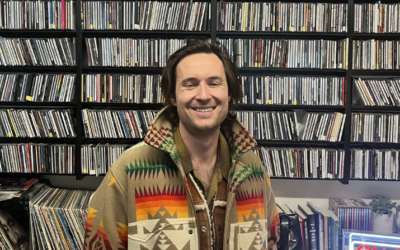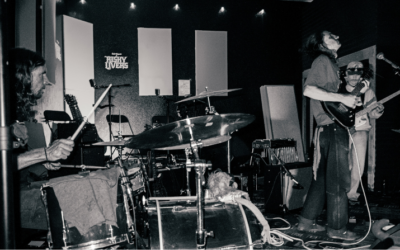

Before Mark Engel began his career as a professional skier, he was a music-lover. From his early days studying the violin to falling in love with bluegrass music, Engel’s always been drawn to the strings. With songwriting and sport, he said, it’s often easy to be your own worst critic. Maybe that song you’re writing sounds like something you’ve already heard. What happens if you don’t win that gold medal? These are all questions along the path to self-actualization according to Engel, who came by the KHOL studios to perform a few original tunes and discuss his career on the stage and the ski hill.
This interview has been edited for length and clarity. – Ed.
Evan Ballew: The people want to know, Mark, what have you been up to this winter?
Mark Engel: I’ve been playing a lot of music. I’m mostly playing with Henry Pepin and the Moguls and also playing with Float Trip, which is a band [you and I are] in together with Alec McKee and Tori Lund. I’ve also been teaching some music lessons. That’s been taking up a good amount of time and also doing some sound. I work at the Silver Dollar [Bar and Grill], the [Million Dollar] Cowboy [Bar], and some private events as well. It’s been a busy winter. What I haven’t been doing a lot of is skiing. It’s a little dreary out there, but I’ve done so much skiing in my life that it’s been a fun change of pace for me this winter.

EB: Could you tell me a little bit about your musical background, how you first got started playing music?
ME: My mom had me take [classical] lessons on the violin growing up, and week after week I would just beg her to not go because I wasn’t enjoying that kind of music. But I think she had some kind of a rule that was like, “You can’t ski if you don’t do your music lessons.” At some point down the line, my friends dragged me to a bluegrass festival. And I was like, “Bluegrass?! I don’t want to listen to that.” I hadn’t really heard it. I remember googling it and hearing just the banjo sound, it sounded like a tin can. And as soon as I heard the music live, I was like, ‘Oh my gosh, this is amazing. Just listen to these rhythms. Listen to what these people are playing on these acoustic instruments.’ My mind was blown and that sparked a love of bluegrass and folk.
EB: Do you find any particular instrument is your primary tool for songwriting or is it less restrained and more free flowing?
ME: Guitar. The one [song] I played on the fiddle, I wrote on guitar, and then kind of adapted over to the fiddle since I haven’t been playing that as long in recent years. I’ve been playing guitar constantly since age 15, but I’m 35 and picked up the fiddle four years ago.
EB: I understand you used to be an Olympic skier, qualifying for Pyeongchang back in 2018, is that correct?
ME: That’s right.
EB: What was that experience like? How did you get into that?
ME: My dad taught me how to ski when I was real young. Me and my brother and sister would all go skiing with my dad. He was a great teacher. When I was a kid, I loved powder days and when it was dumping, because everyone would go inside and I’d be the kid out there who didn’t care about how cold it was or anything. I just wanted to be outside and be skiing. Eventually my parents put me on a ski team. I think there was this little race for six-year-olds and at the end they gave everyone a trophy. But I didn’t know that, and I got this trophy. I was like, “Oh, I must be pretty good at this. I want to do this.” I wanted to be good at something. That’s kind of all I wanted to do as a kid. So I got put on a ski team and kept on racing, eventually made the U.S. team. I was back and forth on the U.S. team and off the U.S. team. It’s hard to qualify, year to year. I kept with it and eventually made it to the Olympics. Fun times, really cool experience to travel the world with a team of people working together and get to experience all those wonderful winter places.
EB: At what point did you decide that that lifestyle was no longer for you?
ME: I remember when I was 27, I was kind of questioning a lot of things and one of those things being how much longer I wanted to be in the sport. And I eventually came to the conclusion, my back and my hips were having some issues, and I remember seeing my good teammate, AJ Guinness. He blew his ACL out for like the third time on the same knee. And I just remember feeling really sick to my stomach. I usually wasn’t affected by those things, but I had already been in that mindset of wondering if [skiing] was worth it. I remembered realizing, I think I want to be healthy for a long time. I also did a lot of self-reflection during those years and started to go to some therapy and realized that a lot of my drive to be on the team was this internal need to prove myself to myself. I’d feel really bad about myself a lot. It was really critical. And through all of that, I’m like, I don’t need to keep proving to myself through this sport.
EB: I’m curious to know if you draw any parallels between your experience as an athlete and your mindset as a songwriter?
ME: In some ways they feel different, in some ways they feel similar. Something I did enjoy on a deep level about skiing is the ability to create and express yourself on the mountain. So that would be like if you’re riding up the lift and looking through the trees and planning a little route for yourself down the hill, you can kind of create and express yourself in the way that you choose to go down the mountain. Or on a race course, I try to pick a line that’s a little bit different than the other racers in certain spots to express myself in a way. Songwriting has been really good for me when I don’t judge myself and just allow it to be a form of expression and just whatever’s on the inside, let’s just reflect it to outside and then take a look at it without judging.
EB: What do you think about the scene here in Jackson? What do you think the music scene’s strengths are? Any notable weaknesses that stick out to you?
ME: I think the musicians here are all community-oriented and supporting of each other. I think a strength of the area is folk, bluegrass, that kind of music. I’d say maybe a weakness is that’s what sells the easiest to tourists because people come to Jackson to experience “the West.” Having space for other artists and other musical styles is important to the music scene. And I know there’s places and people doing that.
EB: Is there any nugget of advice you would give to a younger version of yourself?
ME: Be nicer to myself. Earlier on, if I had realized that I was mostly motivated by this lack of self-worth and needing to prove myself to myself. And being really scared of failure. That was a detriment in my athletic career. It made me really nervous at races because if I were to crash or crash in the race, it wasn’t just that, it was like, “Oh no, I’m failing myself. I’m failing.” There was this underlying fear that made life difficult. And it kind of comes down to me to just be kind to myself and be like, “You know, this is just a construct, just give yourself grace.”