
Make our newscast part of your daily listening routine. Subscribe on Spotify (or wherever you listen to podcasts).
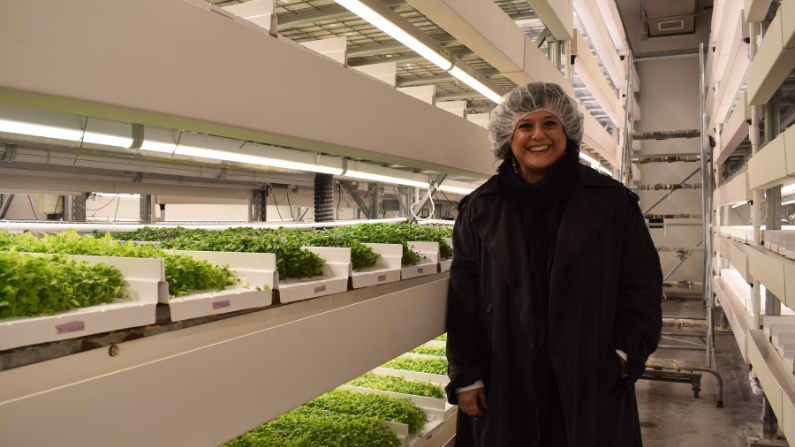
Nona Yehia puts on a hairnet and booties before stepping into the highly controlled room of a new “farm within a farm.”
The Co-founder and CEO of Vertical Harvest is inside a “germination chamber” about the size of a three-car garage. It controls temperature, humidity and light to maximize yields. Yehia gestures toward a few rows of microgreens. She expects the premature plants to be served in Jackson restaurants in December. Most of the surrounding racks are empty.

This is a much smaller space for growing produce than what the decade-old company started with nearly nine years ago. A purple and warm orange glow no longer emanates from the three-story glass facade in downtown Jackson. Windows filled with rows of plants under LED lights were eye-catching, but it wasn’t efficient.
With grow lights hidden, and the microgreens not yet back in Jackson grocery stores and restaurants it could be easy to assume the business was closing altogether.
But Yehia said her company is bucking the industry trend.
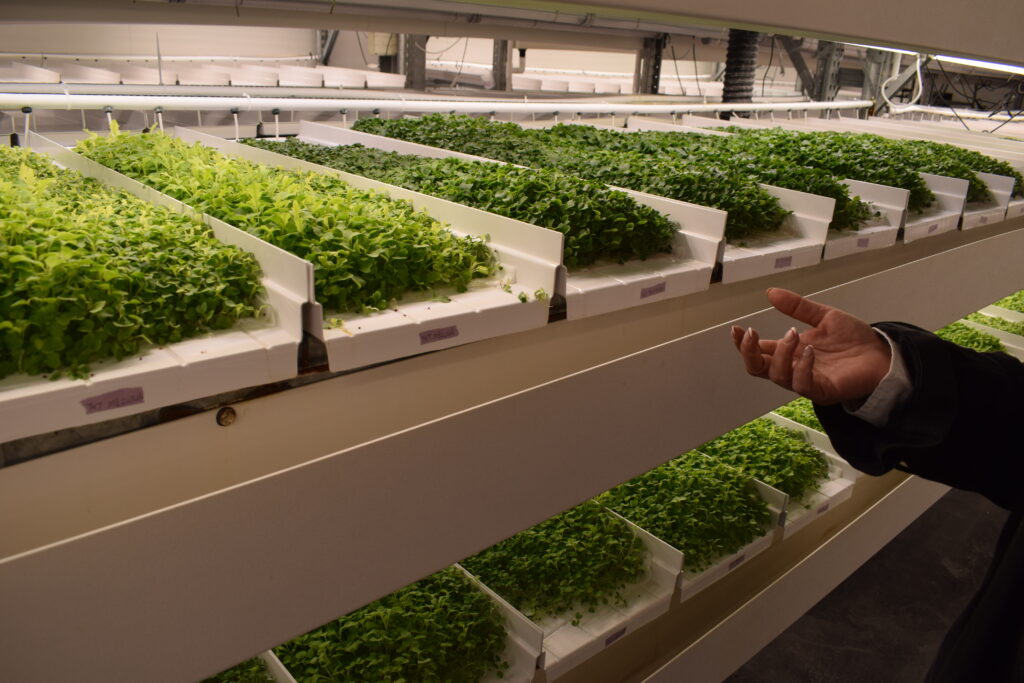
Microgreens are grown more efficiently after upgrades in Vertical Harvest’s Jackson building. (Dante Filpula Ankney / KHOL)
“There are no guarantees in life, but Vertical Harvest is a company that is growing,” Yehia said. “Right now we have no plans of shutting down.”
Those empty racks in the chamber, and in other rooms in the 13,500-square-foot building, will soon fill with head lettuce, microgreens and herbs as Vertical Harvest ramps up in Jackson following a two-year lull.
In October 2023, Vertical Harvest halted farming to update the building’s heating and water systems alongside other infrastructure upgrades. Yehia, an architect by training, said staff noticed poor water quality threatening produce safety. She declined to name the specific issues in an interview, and said private but not public testing agencies were involved. Vertical Harvest issued a voluntary recall and the company “went above and beyond what was necessary” to fix it, Yehia said.
In May 2025, sales started to trickle in at the People’s Market.
However voluntary, the hiatus meant the business wasn’t making sales and bringing in revenue, Yehia said. Besides growing local food, the “low-profit” business aims to combat the climate crisis and support a disadvantaged population. Around 40% of the company’s workforce has a physical or intellectual disability.
But Yehia said Vertical Harvest turned the setback into an opportunity by temporarily pivoting its founding site from a farm to an “incubator.”
Arik Griffin, chief of farm systems, said during the produce pause, the company has partnered with the University of Wyoming, bridging the gap between academia and a real business scenario.
Jackson employees test and perfect growing conditions that could then be grown in a facility finished in 2023 in Westbrook, Maine. The company also has renderings and plans to open another facility in Detroit, Michigan.

Arik Griffin, chief of farm systems, said during the produce pause, the company has partnered with the University of Wyoming, bridging the gap between academia and a real business scenario. (Dante Filpula Ankney / KHOL)
“And then we can also take those learnings and apply them to our large-scale facility [in Maine],” Griffin said.
Unlike Westbrook, Jackson Hole’s high real estate costs and small population make scaling difficult, Yehia said. To save on rent, the business also recently moved out of nearby office space. A company-branded van is for sale nearby.
Downsizing in Jackson while launching in Westbrook comes at a challenging time for the entire vertical farming industry, which Vertical Harvest has helped pioneer.
Several major vertical farms across the country have declared bankruptcy in recent years, with some shuttering altogether. That’s despite billions of dollars invested by venture capital firms and millions from federal, state and local governments.
Vertical Harvest alone has received more than a combined $1.5 million from the Jackson Town Council, Wyoming State Loan and Investments Board and the Wyoming Business Council.
In Maine, as in Wyoming, getting off the ground hasn’t been easy.
Despite more than $55 million in public and private financing, Vertical Harvest owes about $40,000 in unpaid taxes to the city of Westbrook, the Portland Press Herald reported in October. The company has 18 months from then to settle up before risking foreclosure.
City of Westbrook Administrator Jerry Bryant said the city has worked closely with Vertical Harvest and expects the lien to be paid in a matter of months.
Outside of the growing chamber in Jackson, rooms built for growing have no greenery. Instead, cardboard boxes lie on the concrete floor, algae-ridden carousels sit idle, and growing racks and shelves are wiped clean. Yehia said recent changes will up production to twice what the company started with.
“It’s been a challenging period,” Yehia said, “but we’re really excited about 2026 and achieving stabilization.”
Jacksonites will soon be able to purchase Vertical Harvest veggies in Whole Foods, Albertsons, Persephone and Cafe Genevieve. Yehia sees the startup as having learned from predecessors and matured to “vertical farming 2.0.”
That growth will likely be most visible in Maine. Compared to Jackson, the Westbrook facility is about four times the size, with about 20 times the growing space. It boasts the equivalent crop area of about 250 acres on a traditional farm, Yehia said.
With nearly eight times Jackson’s population, Westbrook also has more mouths to feed. The business plans to grow over 3 million pounds of produce annually to sell around the Portland region. Yehia expects sales to New England restaurants and grocers in January 2026.
“What we say is that we’re operators and that operators really understand how to continuously problem-solve and how to continuously do better and iterate,” she said.