Make our newscast part of your daily listening routine. Subscribe on Spotify (or wherever you listen to podcasts).
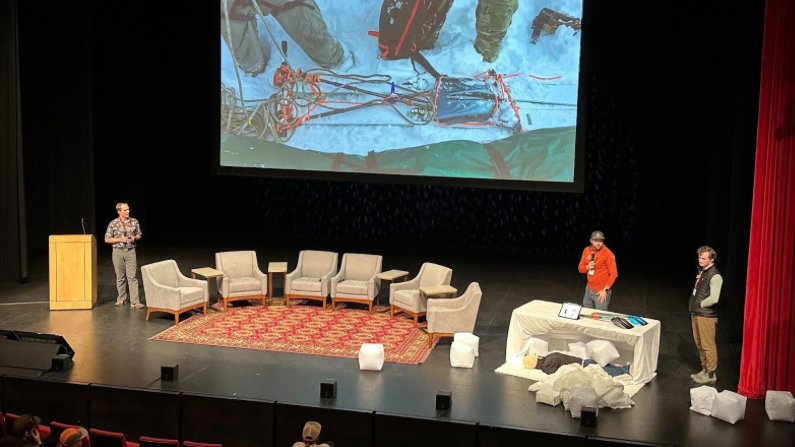
TJ Hartridge waved his hands from hip to head, doing jumping jacks to get his heart rate up, to simulate the stress of unburying an avalanche victim, on stage.
The University of Utah doctor and ski patroller presented in front of hundreds during Teton County Search and Rescue’s Wyoming Snow and Avalanche Workshop at the Center for the Arts on Nov. 14.
He dug through inflated white blocks of “snow” underneath a table to reveal a mannequin or a victim with an obstructed airway.

“It’s a little arts and crafts project,” Hartridge said, “the hope being that other organizations, patrols, guide companies might see this stuff and go, ‘Oh, cool. Here’s an opportunity that we can bring to our local community.’”
It’s all part of an effort to fill a gap in training he’s noticed. Avalanche and wilderness first aid or responder courses typically teach how to locate a victim and – if needed – prep them for medical care.
But he wants to encourage rescue professionals to not just prepare patients for medical care but administer it themselves.
“I wanted to pick up from there, teaching the basics of airway breathing and circulation,” he said, “what first aid and resuscitation can we offer these patients?”
Each year, avalanches kill about 28 people in the United States, according to the National Avalanche Center. Since 2020, 13 people have died in avalanches in Wyoming, according to the Bridger-Teton Avalanche Center. He hopes the presentation inspires some ski patrollers and rescuers to seek additional training on life-saving medical care and others in the know to get a refresher.
Other presentations at the 11th annual conference included using drones to mitigate avalanches and how to manage stress in high-stakes rescues.
You can find more resources on Hartridge’s presentation online at aftertheavalanche.org.