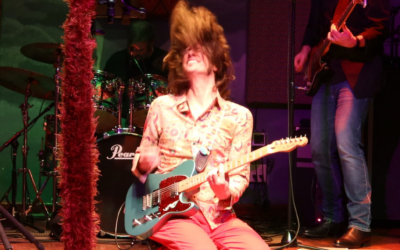

Songwriters have long held the responsibility of providing a voice to the voiceless. For Tennessee native, Bea Jones, finding her voice has always come naturally. She believes that good music is supposed to make you feel something (anything) even if the lyrics don’t always resonate in one particular context. Jones moved to Wyoming to follow her dreams of living under the big sky and joining a community that values vulnerable and honest songwriting. Jones stopped by KHOL to perform a handful of unreleased tunes and chat about her love for Americana music, her unforced approach to songwriting and why she loves being a working musician in Jackson.
This interview has been edited for length and clarity. -Ed.
Support for this arts and cultural coverage comes from the Wyoming Arts Council.
Evan Ballew: What initially led you to Jackson?

Bea Jones: Honestly, I had no idea about this place. I was living in South Dakota, working with horses out there, and I just knew that I wanted to live in Wyoming. Not for a real specific reason, outside of just feeling like I was supposed to be here, though I’d never been before. I planned to move to Cheyenne and it just didn’t feel quite right when I went to visit for the first time. I was back in South Dakota, and I heard some ladies talking about a cool place, and so I was like, ‘Hey, is that place you’re talking about in Wyoming by chance?’ You never hear that question. And they’re like, ‘Actually it is.’ ‘Perfect, I’m gonna move there. What’s it called?’ And then I was here two weeks later. So it kind of just all fell into my lap really.
EB: That’s so cool that you’ve actually lived the rancher life and are able to draw directly from those experiences. Could you describe your typical songwriting process?
BJ: I’ve taught songwriting classes, but honestly, I never teach my process. And that’s because I just let music come to me. And I kind of feel like it’s a superpower in a way because a lot of the songs that I write and that you hear, they’ve never been from hour-long sessions of just sitting down. It’s usually a thought and I’m like, ‘I really want to write a song about that’ or I hear a melody in my head and I’m just like, ‘Perfect timing.’ So I drop everything in the moment and I just start writing. Usually it never changes from its original version. Maybe it’s not that great of a song, but it loses the magic of the moment once you start trying to over-correct it and redirect it, so I just leave it be.
EB: What have you been listening to recently that’s left you feeling inspired?
BJ: I have just been listening to just a lot of stuff about God lately and nature is what inspires me and what makes me feel closer and more connected. With Easter being last weekend, I just feel like that brought hope to my spirit and knowing that spring is coming after this dreary winter, just expecting more to bloom here in reality, in nature and in life as well.
EB: Might be my favorite time of the year out here [right now]. What is it about Americana music that you find the most appealing?
BJ: As Americans I think we have this great opportunity. we’re still cultivating a culture and so it’s very cool that the music reflects culture change in the core and the heart of America. It’s just true and relatable and I just love it for the storytelling. Normally [in] my songs I hope to tell stories well and relay a message well. I wrote “Tommy Lee” about my grandpa but at the same time I still know several people in my life who have had struggles with illness and knew that they were not gonna be able to live forever. It’s like ‘Hey I know that I have to leave y’all behind but you’ll be okay’ and that was the story of many people in my life. But knowing that I can even relay that story to more than just my grandparents, that hopefully people listening can, too. And so I just think this storytelling has a way of drawing in community
EB: Do you have any influences that are well outside of your genres?
BJ: I guess this person, when you listen to my music, you probably wouldn’t hear her, but I love Janis Joplin. You wouldn’t be able to listen to my music and be like, ‘Oh yeah, this was Janis Joplin-inspired.’ But I just love the feel; she creates an atmosphere with her voice. I kind of aspire to be that way and, even if you may not be able to discern what she’s saying, sometimes you get the translation through how it makes you feel. She inspires me to write what I feel, but also to sing it how I feel it, and hoping that even if the specific words don’t really exactly correlate to you, then you would feel what I’m feeling too.
EB: What’s your experience been like as a working musician here in Jackson?
BJ: Getting me to do what I do today, there were a lot of people who believed in me before I believed in myself. This was never really a road I expected myself to go down and because I wasn’t focused on that, all the things that happened really were because of these other people that believed in me. I’m so grateful for them and I tell them that all the time because I wouldn’t be doing what I am doing today, it would have never crossed my mind. When I was like ‘I’m just gonna do this full-time’ it really just felt like I already had enough. I spent enough time building and saying ‘yes’ it just got to the point I was like, ‘Oh, I can do this’ like it’s still here. Now it’s a little bit different because there are so many musicians in the valley who’ve been inspired to play more music and to get out there and so now we’re saturated to the point where it’s not like people are knocking down my door anymore because they need a musician. I’m not mad about that by any means, I think it’s wonderful.