Rejecting the idea of a brain transplant implies we’re greater than the sum of the chemicals firing off inside the three-pound organ. But is it the same reason we might reject much-needed medication? Or reject love?
Off Square Theatre’s rendition of Lucy Prebble’s 2012 “The Effect” takes on these questions with a digitally-enhanced surveillance-style set directed by New York-based Michelle Tattenbaum. The play is recommended for mature audiences.
Off Square’s Producing Artistic Director Natalia Macker came in to talk with KHOL’s Managing Editor Sophia Boyd-Fliegel ahead of the show’s last weekend, Oct. 22 – 25, in the Center for the Art’s Black Box Theatre

This interview has been edited for length and clarity. – Ed.
Sophia Boyd-Fliegel: This play is set in a clinical trial. It features the administering doctor and two young college-age volunteers who are getting increasing levels of dopamine. They keep breaking the rules of the trial and telling themselves that they’re falling in love or maybe it’s just the drugs. The show is about depression and the costs of our contemporary cures for depression. But all along there are these eerie questions about what’s going on in our brains. What is one of the questions that you are thinking about most?
Natalia Macker: The overarching question for me in this play is what makes us who we are? It’s part of the conversation that we have with kids of “nature versus nurture.” And are we the environment that we grew up in? Are we our brain? Are we our gender? Are we the chemicals that our body naturally produces that we often are making or seeking medication to support or amplify or suppress or heal? Because it is also a play that is exploring who we are through a lens of questing for love and connection and partnership. It amplifies that by then asking the question of, are we who we are or how we present ourselves to be?
SBF: Many of us either take antidepressants or are close with someone who is taking antidepressants. Or maybe someone who has chosen not to because they don’t want to feel this titular “Effect,” like a side effect. Have you had any conversations with people who are surprised by the way that they relate to the characters in the play?
NM: I had one conversation where it was related back to me that I don’t think there’s one mentally “healthy” person in that play, which the play talks about. For me personally, I don’t think we’re designed to just be happy all the time and that that’s not part of the human experience, whether you want it or not. Even some of the kind of analysis that we were doing as we were creating the show about expanding and opening empathy for all of those perspectives. I think the play does that because it presents a variety of ways of approaching mental health [and] personal agency. This comes out very minorly in the play of how therapy is also really valuable.
SBF: Another one of those contemporary conversations that I was surprised by in the play was the relationship to technology. And I thought back to Dr. Anna Lempke’s talk here at the Center earlier this year about dopamine. She’s the author of “Dopamine Nation.” That being the main drug administered in these clinical trials. At one point in there’s a physical fight between the lovers and main characters over phones that they’ve carried illicitly.
NM: Absolutely. And that relevance, I think, has only amplified to be doing the play now than when it was originally written. The play is set today, and right now, this is happening in 2012. To introduce those kinds of questions and conversations in the scene where we see them actively going back and forth, that is one of my favorite design moments in the show. We’re creating this experience of sound and lighting, like what is that feeling of a dopamine hit that you’re getting when your message is getting responded to the way you want it. And if our phones today are one of our primary, if not the primary tool for connecting with another person, often more so than talking like we are face-to-face, how much more are we relying on that for those regular doses?
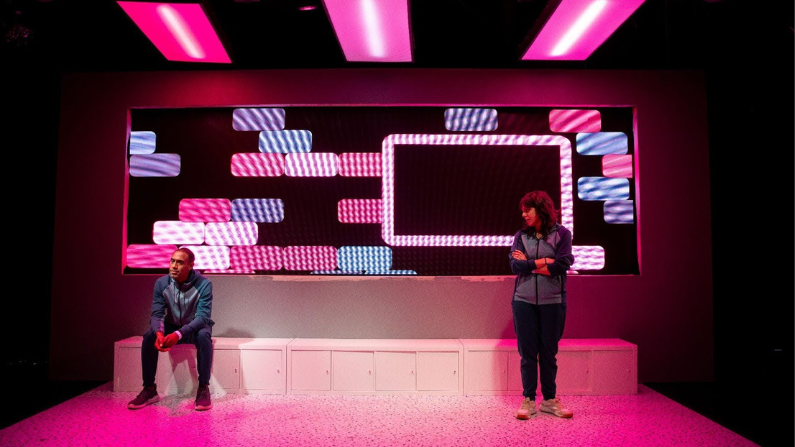
SBF: I’m not a theater nerd, but I did see some things in here that were new to me. It’s an intimate setting in the Black Box [Theatre], but there’s this clinical feeling. Obviously it’s a clinical trial, but you have this effect of fluorescent lighting, and then this digital screen that is behind the set the entire time, kind of giving us narrative help. But also it transforms into a more mystical, religious space at one point with the use of projections, too. Talk to me about what’s new in this set for the Black Box.
NM: We were really excited to be ambitious on the technical side with the show. When we decided to program it, I knew that we didn’t want to do an overly literal interpretation. The way that it’s written and the speed at which things transition doesn’t invite having every piece of medical equipment around. We wanted it to be the clinical trial lab setting and set it in the three-quarter thrust by having an audience on three sides. It adds to that constant observation that [we feel] in the world right now but also in a trial setting where you’re being asked to monitor and comment on every single thing that you’re experiencing and it’s hard to know what’s going on. And there’s only one scene in the first act that isn’t in that clinical setting. That was a conscious choice of how can we both, from a theater side build some new muscles, try something different in the Black Box. We did “Annapurna” in 2018, where we built a trailer inside the room. And “Sweeney Todd” [in 2025], which was a completely different orientation and immersion. In this, you come into the room and say, have I been in this room before?